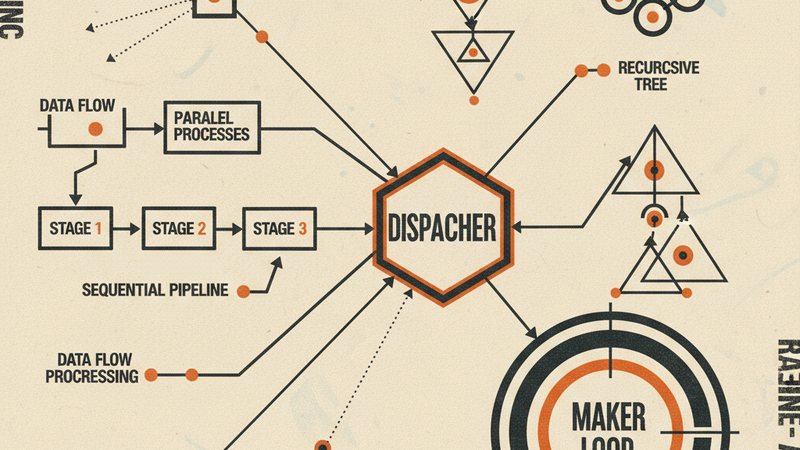
Getting multiple AI agents to coordinate without stepping on each other is the hard part. This skill gives you the architecture patterns and coordination glue — schema-first tools, typed contracts, permission inheritance, and lifecycle management that keeps things from falling apart at scale.
Install
/plugin marketplace add 2389-research/claude-plugins
/plugin install building-multiagent-systems
What it does
Before writing any code, the skill asks six discovery questions about your starting point, scale, state requirements, and constraints. Based on answers, it recommends one of seven coordination patterns:
Fan-out/fan-in for embarrassingly parallel work — spawn reviewers, analyzers, or scrapers and collect results. Sequential pipelines when each stage depends on the last. Recursive delegation for hierarchical task breakdown with depth limits. Work-stealing queues for batch processing at 1,000+ tasks. Map-reduce to keep costs down — cheap models for the map pass, smart models for the reduce. Peer collaboration when you need diverse perspectives from an LLM council. MAKER for million-step zero-error execution in domains like medical or financial processing.
Each agent follows a four-layer architecture: reasoning (the LLM), orchestration (policy and routing), a tool bus (schema validation and execution), and deterministic adapters (file I/O, APIs, shell). Everything below the LLM layer is deterministic and independently testable.
The skill also covers wrapping specialized agents as callable tools (sub-agent as tool pattern), self-modification safety when agents can change their own code, and schema-first tool design so sub-agents can discover what’s available without hardcoded knowledge.
How it works
Permission inheritance prevents sub-agents from escalating privileges — children get a subset of parent permissions. Cascading stops ensure no orphaned agents: stop children first, then self, then cancel work and flush events. Heartbeat monitoring catches orphans after parent crashes. Checkpointing saves state after every 10 tool calls, $1.00 spent, or 5 minutes elapsed. Cost tracking aggregates across the full agent hierarchy using hierarchical IDs.