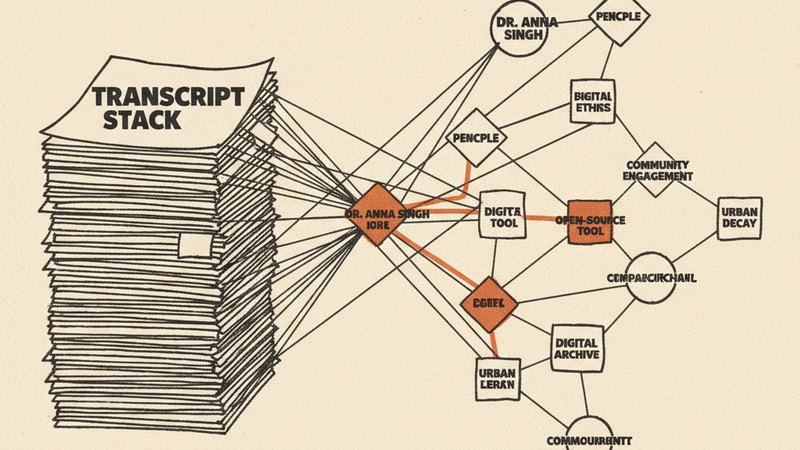
A Claude Code plugin that takes a backlog of meeting transcripts (mostly from Granola) and turns them into a connected Obsidian knowledge graph. Point it at a month’s worth of transcripts and it reads each one, decides which ones are worth summarizing, dispatches parallel agents to process them, and wires everything together with wiki-links.
Install
/plugin marketplace add 2389-research/claude-plugins
/plugin install summarize-meetings
The skill triggers when you say “summarize meetings”, “process meetings”, or “meeting summaries” in the context of vault work.
What it does
Processing runs in monthly batches, most recent month first. Each batch goes through the same cycle: scan the month’s transcripts sorted by size, triage to skip junk, dispatch agents in waves, compile a report.
Triage filters out the noise before any agents spin up. Files under 2K are probably empty stubs. “Untitled” files are almost always nothing. Scheduling fragments, medical appointments, recording setup conversations, garbled recordings — all skipped with a log entry so you know what got dropped and why. Sparse but real notes (like bullet points from a fundraising call) still get processed.
Extraction pulls seven categories from each transcript: people with roles and companies, action items with owners, project ideas, blog ideas, knowledge graph connections between entities, reusable concepts and mental models, and general ideas that don’t fit elsewhere. Each summary gets a 2-4 paragraph narrative recap that reads like someone actually sat in the meeting.
Vault updates are where it gets interesting. The skill doesn’t just write summary files — it creates and updates People notes in People/, checks for existing entries and aliases before creating duplicates, pulls out concepts worth their own atomic note in Concepts/, and stubs projects mentioned in Projects/. Name resolution handles misspellings and nicknames by cross-referencing transcript names against existing vault notes.
Parallel agents keep throughput high. Each wave dispatches 10-15 agents, one per transcript. Large files (50K+) get chunked automatically. After all agents return, you get a report table showing what got processed, what got skipped, and notable highlights.
How it works
Scan month → Triage suspicious files → Dispatch wave of 10-15 agents →
Wait for returns → Dispatch remaining → Compile monthly report
Each agent handles one transcript end-to-end: read it, extract the seven categories, write the summary file with YAML frontmatter, create or update People and Concept notes, then return. The main process compiles everything into a report table with counts of people, actions, and concepts per meeting.
Requirements
An Obsidian vault with meeting transcripts in Meetings/transcripts/. Works best with Granola transcripts but handles other formats. The vault should have People/, Concepts/, and Projects/ directories for knowledge graph updates.